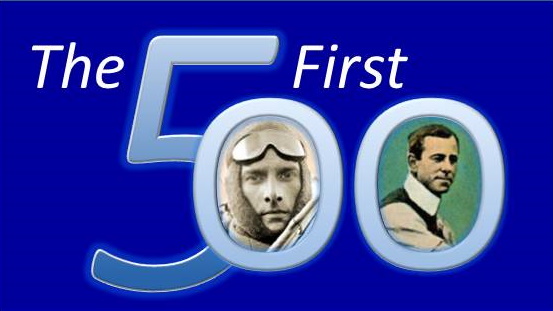
 Collyns Price Pizey was born on 1 April 1883 in Clevedon, Somerset, the son of George Frederick Price Pizey and Sarah Maria Pizey (née Land). When Sir George White asked George Challenger to become the British and Colonial Aeroplane Company's chief engineer and works manager, Challenger accepted and chose Pizey, an apprentice in the company's generating station, to be his assistant.
Pizey learned to fly with the Bristol Flying School at Larkhill, Salisbury Plain and gained his RAeC Aviator's Certificate on 14 February 1911, flying a Bristol Biplane. During training Pizey had shown such aptitude for flying that he was asked to remain at Larkhill as a Flying School instructor, and he was later appointed as the schools manager.
That same year Pizey took part in the Daily Mail Circuit of Britain Air Race and was later appointed Chief Instructor at Bristol's Brooklands School, replacing Howard Pixton.
Pizey was commissioned into the RFC on 21 September 1912 as a 2nd Lieutenant (on probation), confirmed in rank on 30 October. On 5 January 1913 he was appointed to the Special Reserve and on 7 August transferred to the Royal Navy Reserve with the rank of Sub Lieutenant. He transferred to the RNAS on its formation on 1 July 1914 and on 4 August was promoted to Flight Lieutenant (RNAS).
Pizey was appointed by the Admiralty as Flying Officer to the British Naval Mission to Greece in September 1913, under Admiral Mark Kerr, to carry out experimental and instructional work and to organise the Greek Naval Air Service, and as such was an acting Commander in the Royal Greek Naval Air Service.
Collyns Price Pizey died of dysentery on 11 June 1915 at Aidipso Eubrea and is buried at the Athens New Protestant Cemetery.
 Louis Maron was born on 10 October 1869 in Lyon, France. He gained his RAeC Aviator's Certificate on 14 February 1911, flying a Bristol Biplane at Salisbury Plain.
 William Hugh Ewen was born on 1 December 1879 in Shanghai, the son of William Stevenson Ewen, a Scottish Missionary, born in Ayrshire, and Selina Ewen (née Blakeway). The family returned to Edinburgh in 1882. William studied at the University of Edinburgh where he earned a Bachelor of Music and served with the Queens Edinburgh Volunteers from March 1897 to February 1902, reaching the rank of Corporal. Ewen gained his RAeC Aviators Certificate on 14 February 1911, flying a Blériot Monoplane at Hendon.
In May 1911 Lanark Town Council - aware of the potential of their Racecourse as an aviation centre - granted a one-year lease to Ewen to establish an aviation school. The school was housed in hangers erected previously for the 1st Scottish International Aviation Meeting eight months earlier. He started his school using a Deperdussin monoplane and on 30 August 1911 performed the first flight across the Firth of Forth, flying the same aircraft. In addition to his flying instruction, several aircraft were constructed at his school. There appears to have been only sporadic flying at Lanark during the next two years, and, in October 1913, the Town Council, dissatisfied with the infrequent use, terminated Ewen's lease.
Meanwhile, at the end of 1911, Ewan had contacted the Caudron Brothers at Rue and his company, W H Ewen Aviation Co Ltd, Hendon, became the registered agent for the construction and sale of Caudron aeroplanes in the British Empire. In 1912 he then founded the Ewen Flying School at Hendon using the Caudron Biplane. By 1914 Ewen was no longer connected with W H Ewen Aviation, and the name of the firm was changed to the British Caudron Co.
Ewan was commissioned as a temporary Lieutenant in the Army Ordinance Department on the 15 November 1915 and seconded to the RFC as an Equipment Officer, Class 1, with the rank of temporary Captain on 1 January 1917. He was appointed Staff Captain on 21 March then Deputy Assistant Director at the Air Ministry on 31 August 1917. He was promoted to the temporary rank of Major on 25 February 1918.
On its formation on 1 April 1918, Ewan received a temporary commission in the RAF with the rank of (temporary Major), and was appointed an SO2 at the Air Ministrybut resigned his commission due to ill health on 9 October that year. In retirement he was granted the honorary rank of Major.
Post war, Ewen was a professional organist, conductor and composer.
Major William Hugh Ewen died of cancer on 26 November 1947 in Edinburgh.
 Gustav Wilhelm Hamel was born on 25 June 1889 in Hamburg, Germany, the son of Dr Gustav Hugo Hamel and his wife, Caroline Magdalena Elise. The family moved to England around 1899 to Kingston-upon-Thames and were naturalised as citizens around 1910. Dr Hamel became Royal Physician to King Edward VII, while young Gustav was educated at Westminster School between 1901 and 1907, and learned to fly at the Blériot school at Pau, France in 1910. He obtained Aéro-Club de France's certificate No 358 on 3 February 1911 and gained his Royal Aero Club's RAeC Aviator's Certificate on 14 February 1911 flying a Blériot Monoplane at Hendon.
In March he won first prize in a race from Hendon to Brooklands and back, and on 14 April 1911 he flew from Brooklands to Hendon in a record 17 minutes. In May he was one of the pilots who took part in a demonstration of flying to various members of the government, where he demonstrated the usefulness of aircraft for carrying dispatches by flying a message to Aldershot and returning with a reply. The 64 mile round trip took two hours, much of this time due to difficulty in starting his engine for the return journey. In July 1911 he was one of the British representatives in the competition for the Gordon Bennett Trophy but crashed shortly after take-off, fortunately without injury. Later that month he competed in the Daily Mail Circuit of Britain race, reaching Thornhill, north of Dumfries, before retiring after a forced landing due to engine problems in which he was slightly injured.
On Saturday 9 September 1911 Hamel flew a Blériot XI the 19 miles between Hendon and Windsor in 18 minutes to deliver the first official airmail carried in Great Britain. He carried one bag of mail with 300-400 letters, about 800 postcards and a few newspapers weighing 23Ib and arrived safely at Windsor around 5.13pm. Included was a postcard he had written en-route.
On 12 October 1911 Hamel made his first cross-channel flight when he ferried a new Blériot monoplane from Boulogne to Wembley. This was the first of 21 cross channel flight that he was to make. Hamel made the first cross-channel flight with a woman as passenger on 2 April 1912, when he flew Eleanor Trehawke Davies from Hendon to Paris, with intermediate stops at Ambleteuse and Hardelot. Later in the month he assisted Harriet Quimby to become the first woman pilot to cross the channel by testing her newly-delivered Blériot monoplane before her flight.
Hamel took part in the first Aerial Derby race, carrying Eleanor Trehawke Davies as a passenger. At first he was credited with the fastest time, since Thomas Sopwith was disqualified for missing one of the control points, but after Sopwith successfully appealed Hamel was relegated to second place.
In April 1913 Hamel made the first cross-channel return flight carrying a passenger, the Evening Standard journalist Frank Dupree, and later that month flew with Dupree as passenger from Dover to Cologne, the first time that a flight had been made from England to Germany. The flight, sponsored by the Evening Standard, was intended to draw attention to Britain's need for military aircraft.
Late in 1913, looping the loop was perfected and became a popular event during public flying displays. On 2 January 1914, Hamel took Eleanor Trehawke Davies aloft to experience a loop, and she thus became the first woman in the world to do so. On 2 February he gave an exhibition of looping to the Royal Family at Windsor, making 14 loops before landing on the East Lawn of Windsor Castle. After lunch with the Royal family he gave a second exhibition before returning to Hendon.
In August 1913 a seventy five mile air race around the Midlands was arranged between Bentfield Hucks and Hamel. The take-off point for the contest was the Tally-Ho grounds, adjacent to Cannon Hill Park. Both aviators then flew anti-clockwise around the circuit, landing at Redditch recreation ground, Coventry, Nuneaton, Tamworth and Walsall and finishing at Edgbaston. Hamel won the race by a margin of just twenty seconds.
Following his disappointment the previous year Hamel entered the 1913 Aerial Derby, flying a Morane-Saulnier monoplane. This time he won the competition, completing the course in 1h 15m 49s at a speed of 76 mph despite a fuel leak which resulted in him having to fly part of the course plugging the leak with his finger.
Late in 1913, looping the loop was perfected and became a popular event during public flying displays. On 2 January 1914, Hamel took Eleanor Trehawke Davies aloft to experience a loop, and she thus became the first woman in the world to do so. On 2 February he gave an exhibition of looping to the Royal Family at Windsor, making 14 loops before landing on the East Lawn of Windsor Castle. After lunch with the Royal family he gave a second exhibition before returning to Hendon.
Hamel disappeared over the English Channel on 23 May 1914 while returning from Paris in a new 80 h.p. Morane-Saulnier monoplane he had just collected. On 6 July 1914 the crew of a fishing vessel found a body in the Channel off Boulogne. Although they did not retrieve the body, their description of items of clothing and of finding a road map of southern England on the corpse provided strong circumstantial evidence that the body was Hamel's. At this time of high international tension, there was speculation that he might have been the victim of sabotage, but no trace was ever found and the story faded with his memory. His contribution to flying, however did not end entirely with his death: posthumously published was a seminal co-authored book, Flying; Some Practical Experiences.
 Quinto Poggioli was born on 6 December 1884 in Bologna, Italy. He gained his RAeC Aviator's Certificate on 28 February 1911 flying a Blériot Monoplane at the New Forest Aviation School, Beaulieu, having previously gained his Italian Certificate on 20 February.
 Lewis William Francis Turner was born on 7 January 1884 in Winterbourne Stickland, Dorset, the son of George Edward Turner and Mary Rebecca Turner (née Claber). Educated as an agricultural engineer, he learned to fly at the Grahame-White School at Hendon and gained his RAeC Aviator's Certificate on 4 April 1911 flying a Farman Biplane, and by 1913 had become an instructor at the Ewen Flying School, Hendon.
Turner enlisted into RFC as a Sergeant Pilot on 8 August 1914, with RFC Service No 1369, and joined 1 Reserve Squadron, South Farnborough. He was commissioned as a 2nd. Lieutenant (on probation) in the Special Reserve of Officers on 27 April 1915, graded as Flying Officer on 1 May and posted to France with 16 Squadron on 10 May. He was promoted to Lieutenant on 1 January 1916 and to temporary Captain on 1 March, re-graded Flight Commander, but returned to England and joined 1 Reserve Squadron, South Farnborough, on 24 March as a Flying Officer.
On 1 October 1916 Turner was appointed Chief Instructor of the School of Military Aeronautics, graded as Squadron Commander, and promoted to temporary Major. On 5 January 1917 he was appointed Park Commander. Promoted to Captain, but retaining his temporary rank of Major, he was appointed Assistant Commandant of the School of Technical Training on 10 September.
On its formation on 1 April 1918, Turner received a temporary commission in the RAF with the rank of Major, but was put on the unemployed list on 9 April 1919.
Lewis William Francis Turner died on 13 June 1955 in Blandford, Dorset.
 Maurice Ridley Prentice (although always going by Waldo Ridley Prentice) was born on 14 August 1883 in Kensington, the son of Thomas Ridley Prentice and Esther Prentice (née Grove).
Following an early career in the merchant marine, he learned to fly at the Grahame-White School on a Farman biplane and gained his RAeC Aviator's Certificate on 25 April 1911. He then joined Horatio Barber's Aeronautical Syndicate, Ltd, and flew a great deal on their Valkyrie monoplanes. In July, Barber began to devote his time to more aeronautical research and Ridley Prentice took over the entire management of ASL. When Barber closed the Syndicate in 1912, Prentice joined General Aviation Contractors who held the concession for Anzani engines in the UK and he became a director of the newly formed British Anzani Engine Co. By 1913 he had become the MD of General Aviation Contractors.
He never flew very much after the ASL closed down in 1912 because of early heart trouble, and for that reason he did not join the RFC or RNAS in WWI. Instead, he went into the diplomatic service, in which he served for thirty years, most of it in Lisbon.
In May 1951 he had a bad heart attack, but recovered after three weeks in hospital. However, while staying at the British Club in Lisbon, he died of heart failure on 18 January 1952.
 Eric Cecil Gordon England (incorrectly given hyphenated as Gordon-England in some sources) was born on 5 April 1891 in San Antonio de Padua de la Concordia, Argentina, the son of George England and Amy England (née Atlee). His father was an Estanciero and through his mother he was a cousin of Clement Atlee. He was most commonly referred to as E C Gordon England, as though Gordon England were his surname, which it was not.
The family returned to England in 1901 and he was educated first at New College, Eastbourne, then from 1904 to 1906 at Framlingham College in Suffolk. This was followed by an engineering apprenticeship with the Great Northern Railway works at Doncaster, where he trained as a mechanical engineer.
In 1908, Gordon England left the railways for his first job in aviation, working as an assistant for Noel Pemberton Billing who was trying to establish a flying ground at South Fambridge in Essex. While working for Pemberton Billing he met José Weiss, who designed and built tailless gliders, and Gordon England became an assistant to Weiss. On 27 June 1909, he flew a Weiss glider at Amberley Mount, Sussex on a height-gaining flight that reached 100 feet. Subsequently he carried out tests on a Weiss power-driven machine.
At the beginning of 1910 Gordon England taught himself to fly one morning at Brooklands in three hours on a Hanriot monoplane. On 25 April 1911 he gained his RAeC Aviator's Certificate, No. 68, flying a Bristol biplane. Later in 1911, he joined the British and Colonial Aeroplane Company as a staff pilot, but was soon recognized as a designer. One of his first design jobs was to convert a Bristol T-type biplane into a tractor design, which was then called the Bristol Challenger-England. This conversion was followed by three biplanes (the G.E.1, G.E.2 and G.E.3), all designed by England.
In 1912 Gordon England left the Bristol company, and, in association with James Radley produced the Radley-England waterplane series of aircraft. Radley and England also built and tested the Lee-Richards annular monoplane, which made its first flight in the hands of Gordon England on 23 November 1913. Between 1913 and 1916, he was a free-lance test pilot and consultant engineer, mainly engaged by Samuel White and Co, testing seaplanes to the design of Howard Wright. From 1916 until the end of the war he was General Manager of the Aviation Department of Frederick Sage & Co.
In 1919, Gordon England left Sage to become a consultant, and started an interest in motor racing. He raced successfully on track and road for several years, particularly on the famous Austin Seven. One year he succeeded in securing the title 'Champion of France', and has the unique record of having competed in six consecutive international 200 mile races, always winning an award, including three firsts.
In 1922 he returned to gliding, producing a single seat glider designed specifically for the first British gliding competition held at Itford Hill. It made some competition flights but was damaged on the last day. In 1930 he was elected Chairman of Council of the British Gliding Association.
Also in 1922, along with his father George, Gordon England became interested in building bodies for Austin Seven sports cars. This was not the first time Gordon England had designed a car body: in 1915 he had produced a 'Baby Peugot' featuring a sports body of his own design. Using his skills gained with aircraft, over a period of four years, he designed and patented a new lightweight body made from plywood box-girders and an ash framework covered with thin plywood panels and attached to the frame at three points. This way the body on its three separate mounting points was able to maintain its shape even over rough roads. In 1925, he entered the 24 Hours of Le Mans race using one of his own designs, but he failed to finish. However, this led him to make and sell a series of cars to the public based on his racers. He believed that car performance was being held back by the heavy coachwork being fitted to many models and set about designing bodies largely of plywood covered with fabric and fixed to the chassis with three rubber mountings. To make these George England (Motor Bodies) Ltd was incorporated in 1925.
The first model to be sold was the Brooklands Super-sports Austin 7 and although his racing version had been fabric covered the production version was aluminium panelled. Each one was supplied with a certificate stating that it would attain 80 mph. The "Cup" model followed and then a fabric saloon which came out before the official factory version. In 1927 almost 20,000 bodies were supplied for the Austin 7.
Work extended beyond Austin and in 1925 a Rolls-Royce was fitted followed by work on Bentleys, MG, Morris, Standard and Wolseley. The Putney premises were outgrown and in 1927 the company moved to Wembley and exhibited at the London Olympia Motor Show with an Invicta on the stand.
The company was reformed as Gordon England (1929) Ltd and claimed to be making 35 bodies a day. However, the fabric body started to lose out to all-metal types, the company's fortunes declined and in 1930 it closed.
Gordon England gave up the body-building business and became manager of the automotive lubricants department at the Vacuum Oil Company 1930-1935. He was also President, Motor Agents Association, 1937; Managing Director, General Aircraft Ltd, 1935-42; Deputy Chairman, Aero Engines Ltd., 1936-43; Member of Gorell Committee on Civil Aviation, 1932-33; Chairman, Engineering Industries Association, 1940-44; General manager, Eugene Ltd, 1945-50, Life member of Council British Automobile Racing Club; Founder member of Railway Conversion League and a Member of the Economic Research Council.
In 1945, Gordon England contested the Bury St Edmunds seat in the General Election, standing for the socialist Common Wealth party but failed to get elected.
Eric Cecil Gordon England, FIMI, FRAeS, MIProdE died in Sunninghill, Berkshire, in February 1976.
 Henry Rowland Fleming was born on 8 April 1884 in Aldershot, Hampshire, the son of Patrick Fleming and Marion Fleming. He learned to fly with the Bristol School at Larkhill, Salisbury Plain, and gained his RAeC Aviator's Certificate on 25 April 1911, flying a Bristol Biplane.
Fleming joined the RFC on 22 August 1914 as a 2nd Lieutenant and was posted to the Reserve Aeroplane Squadron. While attending the Central Flying School, he was killed on 24 November 1914 at Upavon when his B.E.2 dived into the ground.
 Charles Cyril Turner was born on 30 April 1870 in Brighton, Sussex, the son of Frank Turner and Amelia Turner. A journalist, Turner contributed a weekly article to the Observer newspaper from 1908 to 1924 without a single break. He watched all the early pioneers. On 18 November 1908, together with Edward Maitland Maitland and Prof. A E Gaudron, he flew in a balloon from Crystal Palace to Meeki Derevi in Russia, a distance of 1,117 miles in 36.5 hours.
During the Press Day at the Bristol School at Larkhill, Archibald Low flew Turner over Stonehenge and his first experience of aeroplane flight persuaded him to take flying lessons himself. He gained his RAeC Aviator's Certificate on 25 April 1911 flying a Bristol Biplane on Salisbury Plain, the first journalist to do so, and was the first journalist to loop the loop, with Gustav Hamel in 1914.
Turner joined the RNVR as a temporary Lieutenant on 8 May 15, promoted to temporary Lieutenant-Commander on 5 Nov 1917. On its formation on 1 April 1918, he received a temporary commission in the RAF with the rank of Major, but was put on the unemployed list on 30 Jan 1919.
Post war he became the Daily Telegraph Air Correspondent and went on to author 38 books about aviation. On 25 February 1920, he was one of the crew of Handley Page O/400 G-EAMC, along with Sqn Ldr Herbert George Brackley and Capt Frederick Tymms which crashed, 6 miles north of El Shereik, Sudan, while competing for the first Cairo·to-Cape flight.
Charles Cyril Turner, AFRAeS died on 7 December 1952 in Croydon, Surrey.