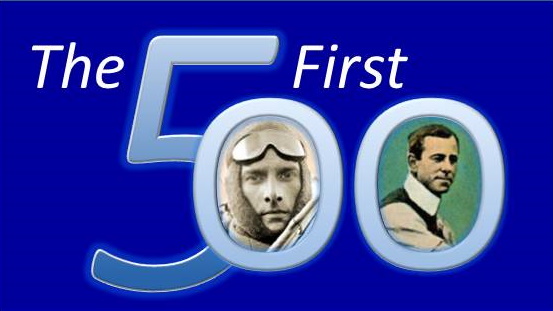
 Herbert John Thomas was born on 20 February 1892 in Hammersmith, London, the son of Samuel Herbert Thomas and Victoria Thomas (née Morjan). He learned to fly with the Bristol School at Larkhill, Salisbury Plain and gained his RAeC Aviator's Certificate on 31 December 1910 flying a Bristol Biplane; at the time the youngest pilot to have been so awarded. He was a founding member of the British and Colonial Aeroplane Company, formed 1910, and stayed with the company under its various names until his death following surgery on 20 May 1947 in Bristol, Gloucestershire, at which time he was assistant managing director of the Bristol Aeroplane Company and High Sheriff of Bristol. He had also served as chairman and council member of the Society of British Aerospace Companies.
 Ellice Victor Elias Sassoon, son of Sir Edward Elias Sassoon, 2nd Baronet of Bombay and Lady Leontine Sassoon (née Levy), was born 30 December 1881 in Naples, Italy, while his family was en route to India. He was raised in England where he attended Harrow and Trinity College, Cambridge. He learned to fly under the assumed name of E V Smith and gained his RAeC Aviator's Certificate on 24 January 1911 flying a Sommer biplane at Brooklands.
Sassoon enlisted as a Lieutenant in the RNVR on 9 November 1914. He was appointed to HMS Victory on 12 August 1915, but his appointment was terminated on 12 December 1915. He was appointed to the RNAS on the next day as an Acting Flight Lieutenant (on probation) and posted to the K Section, Air Department, Whitehall. He survived a plane crash in 1916 and sustained leg injuries that plagued him for the rest of his life. On 20 February 1917 he was posted to the Paris Air Station and promoted to Acting Lt.-Commander on 18 September. On 15 October he was appointed to Special Service with the Ministry of Munitions, but retained on the books of the RNAS.
When his father died in 1924, Sassoon inherited his title and became 3rd Baronet of Bombay. He moved to India, where he managed his family’s textile mills and served in the Indian Legislative Assembly. On 6 July 1929 he was appointed to the Royal Commission on Labour in India.
In the 1920s and 1930s, he transferred much of his wealth from India to Shanghai, China, and contributed to a real estate boom there by investing millions of US dollars in the local economy. Sir Victor frequently traveled worldwide for business and pleasure and divided his time between Poona, India, and Shanghai. He acquired the Cathay Land Company, the Cathay Hotel Company and at least 50 other companies.
Victor Sassoon lived in Shanghai until 1941, when due to China's war with Japan, he was forced to leave. After the Chinese Communist Revolution of 1949, he sold most of his properties in Shanghai, channelled his money to Britain and moved his New Sassoon headquarters to Nassau in the Bahama Islands. The New Sassoon company ended its business in China in 1950. He was appointed Knight Grand Cross of the Order of the British Empire (GBE) on 1 January 1947.
Sir Ellice Victor Elias Sassoon, 3rd Baronet of Bombay, GBE died in Nassau 12 August 1961.
 Geoffrey de Havilland was born on 27 July 1882 at Magdala House, Terriers, High Wycombe, Buckinghamshire, the second son of The Reverend Charles de Havilland, the curate of Hazlemere, and Alice Jeannette de Havilland (née Saunders). His father gained his own parish in Nuneaton, Warwickshire, shortly afterwards, and it was here that Geoffrey spent most of his childhood. He was educated at Nuneaton Grammar School and St Edward's School, Oxford.
Geoffrey's mother disliked living in towns so they moved to a parish at Crux Easton, Hampshire, where the family could return to a rural life. They moved in 1896 but not before Geoffrey and his elder brother Ivon (b. 9 April 1879 in Wycombe, Buckinghamshire – d. 3 December 1905 in Brentford, Middlesex) had installed the first of many generators in the rectory to provide electricity. The two brothers were very close and together they developed an interest in mechanics.
Like his father before him, it was expected that when Geoffrey left St Edward's School, he would train for the clergy. His interest in mechanics, however, showed him that another career could be open to him. In 1900 he began training at the Crystal Palace Engineering School and, after various adventures with Ivon in motor cars, they began to build their own, hoping to compete in the 1903 Gordon-Bennett Race. The car was not finished so they could only spectate.
The Crystal Palace School provided Geoffrey with a sound grounding in mechanical engineering and he built his own motorcycle. After three years he moved to an apprenticeship at Willans & Robinson of Rugby, Warwickshire. While there he constructed a second, more successful, motorcycle which eventually passed to his younger brother, Hereward (b. 2 December 1894 in Nuneaton, Warwickshire - d. 12 September 1976 in Morn Hill, Victoria, Australia), and ran for many years. Indeed when short of money he sold the drawings and patterns for £5 to two student friends who went on to form the Blackburne motorcycle company.
1905 saw Geoffrey move again. He became a draughtsman at the Wosleley Tool & Motor Car Company at Adderley Park, Birmingham, but became bored and left after a year. Ivon had worked for the Daimler Motor Company in Coventry before designing the Iris car which was manufactured by the Iris Motor Company of Willesden, London. This was unveiled at the 1905 motor show shortly before Ivon died. Although his life was short Ivon had introduced Geoffrey to a number of people who would assist him in the future.
Geoffrey resumed work by designing buses for the Motor Omnibus Construction Company in Walthamstow. While there, he met a young engineer from Cornwall named Frank Trounson Hearle (b. 1886 in Penryn, Cornwall - d. 1 September 1965 in Watford, Hertfordshire), who worked in the bus garage at Dalston, and was later to become a director of the de Havilland Company. They moved into a flat in Kensington together in 1907 with de Havilland's sister Ione as housekeeper. She later became Mrs Hearle. While there he designed his first aero engine, the de Havilland Iris, a four-cylinder, liquid-cooled, horizontally opposed unit, and had the first prototype made by Iris Motor Company.
Built with £1000 borrowed from his maternal grandfather, de Havilland's began construction of his first aircraft in 1908 at a workshop in Bothwell Road, Fulham, assisted by Hearle, and powered by de Havilland's Iris-built engine. Even de Havilland's wife Louise took a part in the construction for she was given the job of stitching every seam in the stiff linen cover for the wings. During a visit to his family at Crux Easton, Hampshire, Geoffrey discovered that J T C Moore-Brabazon had decided not to use two sheds three miles away at Seven Barrows on Lord Carnarvon’s estate. He inspected them in August 1909 and acquired them for £150. Lord Carnarvon, famous later for funding the Tutankhamun expedition, gave his permission to fly from his land. The aeroplane was finished at Fulham by November 1909 and was transported to Seven Barrows. Problems prevented flying for some weeks and eventually in December, frustrated, Geoffrey forced the machine into the air, only for it to rise too quickly and collapse. Frank Hearle and Hereward de Havilland rushed to the wreckage and found Geoffrey unhurt. Undeterred they loaded the remains onto a lorry and returned to Fulham.
De Havilland then built a fresh biplane, again using the Iris engine, making his first flight in it from a meadow near Newbury on 10 September 1910. He had no experience of flight and so he had to learn very quickly “on the job”. Indeed de Havilland had only seen one aeroplane in flight when Claude Grahame-White competed for the £10,000 London to Manchester prize. Gradually, however, he acquired experience and confidence so that by November he considered himself an experienced pilot.
On the suggestion of a friend, de Havilland approached Mervyn O’Gorman, Superintendent of the Balloon Factory at Farnborough, with a view to selling his aeroplane to the Army. Just before Christmas the War Office agreed to the purchase and to employ de Havilland with Hearle as his mechanic.
In December 1910, de Havilland joined the Balloon Factory, which was to become the Royal Aircraft Factory, and sold his second aeroplane to his new employer for £400. It became the F.E.1, the first aircraft to bear an official Royal Aircraft Factory designation. He gained his RAeC Aviator's Certificate on 7 February 1911 flying this second biplane at Farnborough.
For the next three years de Havilland designed, or participated in the design of, a number of experimental types at the Factory. He was commissioned as a 2nd Lieutenant (on probation) in the Royal Flying Corps, Special Reserve of Officers, on 16 October 1912, antedated to 2 September. He was confirmed in rank on 24 December and his appointment to the Reserve antedated to 24 November.
In 1912, one of de Havilland's designs, the B.E.2, established a new British altitude record of 10,500 feet, with his brother Hereward was the test pilot.
1913 saw de Havilland’s first “flying crash worthy of that name”. The BS.1, also known as the SE.2, first flew in March. It was fast for its time, achieving a speed of 91.7 mph, and was one of the first single-seat scouts. Unfortunately its rudder was too small and de Havilland crashed while trying to recover from a spin.
In December 1913, de Havilland was appointed an inspector of aircraft for the Aeronautical Inspection Directorate under the Chief Inspector, Major J D B Fulton. Unhappy at leaving design work, in May 1914 he was recruited to become the chief designer at the Aircraft Manufacturing Company (aka Airco), in Hendon. He designed many aircraft for Airco, all designated by his initials, DH. Large numbers of de Havilland-designed aircraft were used during the First World War, flown by the Royal Flying Corps/Royal Air Force.
Following the outbreak of WWI, de Havilland was called up for duty. On 5 August 1914, he was promoted to Lieutenant and appointed a Flying Officer from the same date. His earlier crash injuries prevented him from going overseas; he was briefly stationed in Montrose on the east coast of Scotland as an officer on war duty. Flying a Blériot, he was to protect British shipping from German U-boats. After a few weeks he was released from this duty and returned to Airco. However, he nominally remained in the service until after the end of the war. On 30 April 1916, he was promoted to Captain and appointed a Flight Commander. On its formation on 1 April 1918, de Havilland received a temporary commission in the RAF with the rank of Captain. Appointed an Officer of the Most Excellent Order of the British Empire (OBE) in the 7 June 1918 Birthday Honours, and awarded the Air Force Cross on 1 January 1919, he was placed on the RAF unemployed list on 24 November 1919.
Royalties were paid for each aircraft built to a de Havilland design and he quickly became prosperous and he bought a large house in Edgware. The pressure of work, however, took its toll and de Havilland suffered a nervous breakdown late in 1918. In an effort to find peace the family moved to Balcombe in Sussex, but de Havilland had overlooked the problems of commuting and so returned north, this time to a house in Stanmore, Middlesex.
Airco was bought in early 1920 by armaments group Birmingham Small Arms Company but, discovering it was less than worthless, BSA shut down Airco in July 1920. With the help of former Airco owner George Holt Thomas he formed the de Havilland Aircraft Company on 15 September 1920, employing some former colleagues. He leased the former London & Provincial Flying School site at Stag Lane, near Edgware, for his factory. It was decided that the company should concentrate on civil aircraft for the growing airline market. There was, as yet, no real market for privately owned aircraft. In 1921, however, the company was approached by Alan Samuel Butler (b. 22 November 1898 – d.24 May 1987) who wanted a new aeroplane built for him. This was a turning point for de Havilland as Butler invested heavily in the company, providing the capital to buy premises and then the airfield at Stag Lane Aerodrome, and by 1924 was its chairman.
The Moth series of biplanes, first flown by Geoffrey de Havilland on 22 February 1925, was one of their most successful products. The pressure of business, however, meant that de Havilland had to reduce the amount of test flying he did and also employ more designers as aircraft became more complicated.
Frank Bernard Halford (b. 7 March 1894 – d. 16 April 1955) had designed the Airdisco Cirrus engine using World War One engine components. In 1926 Halford was requested to design a new engine which became the de Havilland Gipsy, and the Engine Division of the de Havilland Aircraft Company was formed to produce it the same year. In 1944 de Havilland bought out Halfords's consultancy firm, forming the de Havilland Engine Company with Halford as head. The company was officially formed at Stag Lane in February 1944 and later moved into a factory leased by the government in 1946 at Leavesden, which had earlier been a site for Handley Page Halifax production.
In March 1927 the de Havilland Aircraft Company established de Havilland Australia (DHA)in Melbourne, its first overseas subsidiary, manageed by Hereward de Havilland. DHA was set up to sell de Havilland products in Australia, to assemble aircraft that had been sold, and to provide repair and spare parts services. In 1930 DHA relocated to Mascot aerodrome in Sydney. In March 1928 the subsidiary company De Havilland Canada was created to build Moth aircraft for the training of Canadian airmen. After the Second World War it went on to design and produce a number of indigenous types, most of which proved highly successful.
In 1933 the de Havilland Aircraft Company moved to Hatfield Aerodrome in Hertfordshire. On 4 June 1934 de Havilland was appointed Commander of the Most Excellent Order of the British Empire (CBE). When World War Two started the company was producing Tiger Moth and Dragon Rapide biplanes. Their most important contribution, however, was the Mosquito. This was one of the fastest and most versatile aircraft of the war. On January 1944, de Havilland was conferred with a Knighthood. When the war finished the de Havilland Company was working on a number of new aircraft. Some were very advanced and at the forefront of research.
De Havilland's increasing age, along with the complexity of modern aircraft design, reduced his direct contribution to the aircraft company and he retired from active involvement in his company in 1955, becoming President of the de Havilland Group. In 1959 his younger brother, Hereward retired as Managing Director of the Airspeed Division further diminishing the family's participation and when the de Havilland Group was acquired by Hawker Siddeley in 1960 Geoffrey's role in the company ceased. On 23 November 1962 he was appointed to the Order of Merit.
De Havilland continued flying up to the age of 70 making his final flight in a DH.85 Leopard Moth, G-ACMA.
Captain Sir Geoffrey de Havilland, OM, CBE, AFC, RDI, FRAeS died of a cerebral hemorrhage on 21 May 1965 at Watford Peace Memorial Hospital, Hertfordshire. After cremation his ashes were scattered over Seven Barrows in Hampshire where he had made his first flight.
 Daniel Goodwin Conner was born 2 December 1884 in Dublin, Ireland, the son of Henry Daniel Conner and Anne Purcell. Educated at Malvern College, Malvern, Worcestershire and the Royal Military Academy Woolwich, he was commissioned in the Royal Field Artillery as a 2nd Lieutenant on 29 July 1904, promoted to Lieutenant on 29 July 1907.
Conner gained his RAeC Aviator's Certificate on 7 February 1911 at Larkhill, Salisbury Plain, flying a Farman Biplane, and was seconded to the Air Battalion, Royal Engineers, on 6 June.
Seconded to the RFC on 13 May 1912, Conner was promoted to the rank of temporary Captain and graded as Flight Commander on 1 July 1912. He was confirmed as Captain and joined 3 Squadron on 15 December 1912 at Larkhill, Salisbury Plain, relocating with his squadron to Netheravon on 16 June 1913. Transferred to 5 Squadron, he embarked for France on 14 August 1914, but returned on 1 October to take command of an Aircraft Park and on 3 March 1915 was made Equipment Officer. In September 1915, now promoted to temporary Major and graded as Squadron Commander, Conner was in command of 1 Aircraft Park at St Omer and by July 1916 was OC Second Army Aircraft Park at Hazebrouck, graded as Park Commander. On 9 September he was confirmed in rank as Major. Promoted to temporary Lieutenant-Colonel, Conner became Depot Commander on 1 January 1917.
On its formation on 1 April 1918, he received a temporary commission in the RAF with the rank of Lieutenant-Colonel, and appointed Group Commander, with the temporary rank of Colonel (Equipment), on 18 May. He was was appointed an Officer of the Order of the British Empire (OBE) in the 1919 Honours List and awarded a permanent commission in the RAF on 1 August 1919 as a Colonel (Wing Commander when the RAF introduced its own ranking system the same day).
Conner relinquished his commission in the RAF on 24 January 1920 and returned to the Army with the rank of Major. He retired from the Army on 7 January 1922 with the rank of Lt.-Colonel.
Post war, Conner mover into the ecclesiastical world. Reverend Daniel Goodwin Conner died on 23 January 1943 at Castleventry Rectory, Cork, Eire.
 James Vernon Martin was born on 31 March 1883 (per his RAeC Aviator's Certificate - other sources quote 1885) in Chicago, IL, USA, the son of William G Martin and Jessie Emily Martin (née White). He joined the Merchant Marine in 1900 before attending the University of Virginia and Harvard, where he attained a graduate degree in 1912. While at Harvard he organized the Harvard Aeronautical Society in 1910, served as its first director, and, through the Society, organized the first international air meet in the United States, also in 1910. Martin travelled to England in January 1911 for flight training, learned to fly at the Grahame-White School and gained his RAeC Aviator's Certificate on 7 February 1911 at Hendon, flying a Farman Biplane. After returning to the U.S. in June 1911, he traveled the exhibition circuit before rejoining the Merchant Marine as Commander of USS Lake Frey in 1914. During 1915 he flew flight test for the Aeromarine Co.
In 1917, he formed the Martin Aeroplane Company in Elyria, OH on the strength of nine aeronautical patents, including his automatic stabilizer (1916) and retractable landing gear (1916). In 1920 he moved the concern to Dayton, OH as Martin Enterprises and offered free use of his patents to the American aeronautical industry. He moved to Garden City (Long Island), NY in 1922, called the company the Martin Aeroplane Factory, and, two years later, sued the United States government and the Manufacturers Aeronautical Association, claiming that they conspired to monopolize the aviation industry. The suit was dismissed in 1926, but Martin continued to press his claims of collusion through the 1930s.
During World War II he again returned to the sea, commanding a troop transport in the Pacific. Afterwards he tried to raise interest in a large catamaran flying boat, the Martin 'Oceanplane', but failed in the face of the growth in commercial trans-ocean service by conventional aircraft.
James Vernon Martin died on 25 February 1956 at Paramus, Bergen, New Jersey, USA.
 Arthur Haynes Aitken was born on 14 December 1880 in Helensburg, Dumbartonshire, the son of James Aitken and Emily Aitken (née Hill), and entered St Barts Hospital as a medical student on 12 October 1900. He was commissioned as a 2nd. Lieutenant in the Cork Artillery on 21 August 1901 and promoted to Lieutenant on 11 June 1902, but resigned his Commission on 22 October 1904.
Aitken learned to fly at the New Forest Aviation School, Beaulieu, and gained his RAeC Aviator's Certificate on 14 February 1911, flying a Blériot Monoplane.
Arthur Haynes Aitken, who, due to tuberculosis, had spent much time at Sanatorium Schatzalp in Davos, Switzerland, died on 10 July 1918 in Chamounix, France.
 Charles Louis Andre Hubert was born on 16 March 1889 at Cherbourg, France. He learned to fly at the Grahame-White School and gained his RAeC Aviator's Certificate on 14 February 1911, flying a Farman Biplane at Hendon, following which he became an instructor at the Grahame-White School. On 11 September 1911, during King George V Coronation airmail flights, Hubert attempted to take off with eight bags of mail, which are reported to have weighed about 200 pounds, but crashed his Farman III at Hendon airfield, breaking both his legs. Hubert returned to flying in May 1912, and then joined the Frank Hucks Waterplane Company, Ltd as pilot.
At the outbreak of war, Hubert returned to France to become a Sapeur-Aviateur of the Service d'Aviation Militaire, and appointed to Escadrille M.F.88 with the rank of Sergeant. In October 1917 Hubert returned briefly to England, when, on 3 November, Adjudant-Pilote Charles Hubert, Croix de Guerre, married Bettie Xenie Ewart in London.
Post war, Hubert lived in Paris and appears to have become a merchant.
 George Henry Challenger was born on 3 June 1881 at Neath in Glamorganshire, Wales, the son of Charles Challenger and Emily Challenger (née Foster).
Challenger was originally employed as an engineer at Bristol Tramways and Carriage Company, where his father was Chief Engineer.
With the formation of the British and Colonial Aeroplane Company in 1910 which started with leased premises from the Bristol Tramways and Carriage Company Challenger moved across to the new aeroplane company as works manager and engineer.
After seeing detailed drawings of the Farman III in Flight magazine, Challenger told Sir George White, chairman of British and Colonial Aeroplane Company, that he was pretty sure he could build a copy of the plane. White told Challenger to go ahead and a few weeks later, the first copy was constructed, using materials from partially built Zodiac aeroplanes. With this, the Bristol Boxkite was born. He went on to design several more aircraft for Bristol, most bearing his name: the Challenger-Grandseigne, Challenger-Low and Challenger-Dickson
With the creation in 1911 of an experimental department, Challenger was sent to Larkhill to learn to fly and on 14 February 1911 he gained his Royal Aero Club Aviator's Certificate flying a Bristol biplane.
However, Challengers time with Bristol did not last much longer. With the formation of an aeronautical division by Vickers, Challenger left Bristol to work for the new company as chief designer and engineer. He was the involved in numerous patents, including those for a ring mounting and a gun synchroniser, both for machine-guns. He resigned from Vickers in 1918, having taken part in designing the many different aircraft types produced during the First World War. In its obituary of him, Flight states that 'Challenger was an upright man who brought his religious convictions into everyday life'and perhaps that prompted his resignation from a company that made armaments.
By 1939 Challenger was a village store keeper and Air Warden, living in North Curry, Taunton.
Challenger died on 4 December 1947 at Stoke St. Gregory, near Taunton, Somerset.
 George Richard Sutton Darroch was born on 22 February 1880 in Kensington, London, the son of George Edward Darroch and Adelaide Frances Darroch (née Valpy ). Darroch went to Eton College and in 1899 was apprenticed to the London & North Western Railway (LNWR) in Crewe. Darroch left the Crewe works in 1905, moving to Reigate in Surrey, where he was an automobile engineer at Reigate Garage Limited.
Attracted by early flying, he learned to fly at the Blériot school, Hendon and gained his RAeC Aviator's Certificate on 14 February 1911 on a Blériot monoplane. He bought an aeroplane of his own and complemented it with a fiercely powerful Itala car, then regarded as the last cry in stylish motoring.
On the outbreak of WWI, Darroch helped to organize a motorized unit under the aegis of the Royal Armoured Corps; it saw action at the battle of the Marne. Having been declared medically unfit for the British army, Darroch volunteered at once for the French army, seeing plenty of action thereafter as an ambulance driver in the thick of fighting on the grim Balkans front. He was awarded the Croix de Guerre.
Invalided out once more, he returned to Crewe in June 1917, eventually becoming Assistant Works Manager with the LNWR and its successor, the London, Midland and Scottish Railway, finally retiring in 1941. During his first employment in Crewe he designed and supervised the construction of the ""Orion"", a one-sixth scale model Webb Compound locomotive now maintained and operated by the Stephenson Locomotive Society.
Unmarried, George Richard Sutton Darroch died on 3 December 1959 in Crewe.
 Archibald Knight was born on 21 October 1887 at Harefield, Gloucestershire, the son of Edward Knight and Rosa Emelia Knight (née Parker). An employee of Vickers, he learned to fly at the Bristol Flying School, Brooklands and gained his RAeC Aviator's Certificate on 14 February 1911, flying a Bristol Biplane. He then became an instructor at the Vickers Flying School.
Following the outbreak of WWI, Knight enlisted in the Royal Flying Corps on 1 May 1915 as a 2/AM and was promoted to Sergeant the following day. He embarked for France with 27 Squadron on 13 July 1916, returning to the Home Establishment on 17 August. Promoted to temporary Sergeant Major on 2 May 1917, he transferred to the RAF on its formation on 1 April 1918.
Knight was discharged from the RAF on 31 March 1919 on being recalled to join Maxwell Muller in managing the Vickers works at Weybridge, where he remained as works manager until his retirement in 1936. Knight later returned to Vickers in 1939 to manage Wellington and Warwick repair.
Archibald Knight died on 17 January 1960 in Weybridge, Surrey.